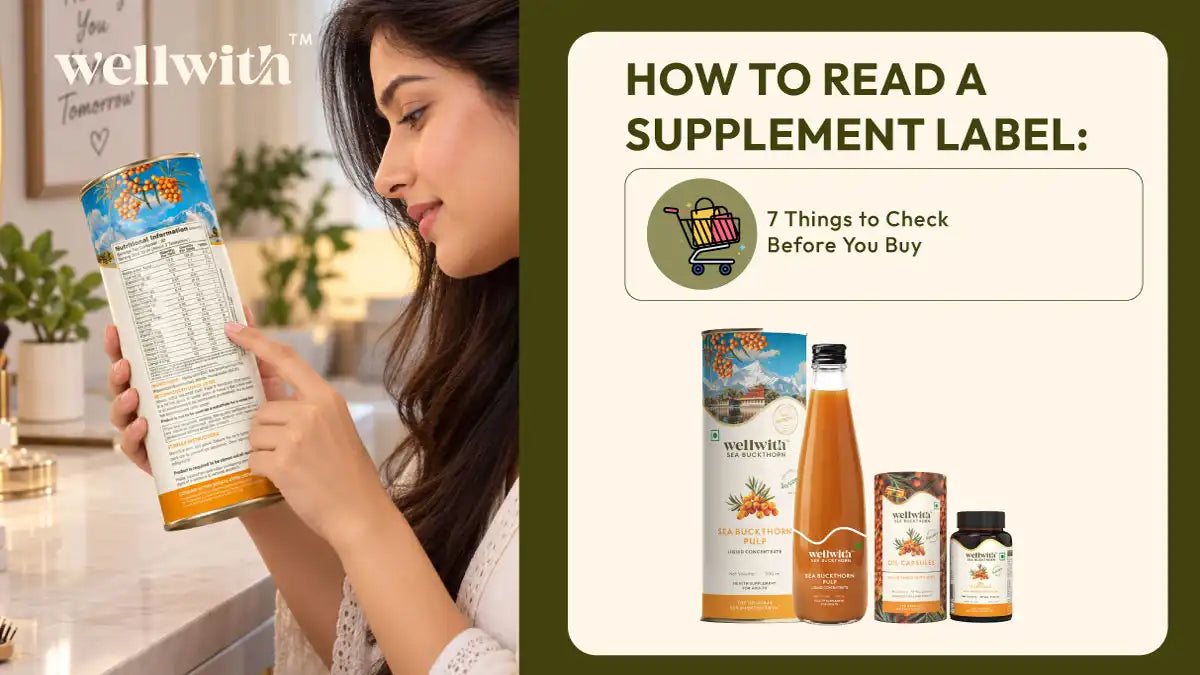

Whether it be walking into a pharmacy or surfing the web for wellness advice, chances are you will come across bottles upon bottles of supplements that promise the same things: enhanced immunity, clear complexion, and improved energy levels. However, not everything that is advertised is always true. The only way to ensure the truthfulness of a product's contents is to understand its label.
Take a sea buckthorn supplement, for instance. It's having a moment right now, and for good reason. This small orange berry is genuinely packed with nutrients. But two bottles labeled "sea buckthorn" can be worlds apart in quality, depending on how they're sourced, processed, and standardized. So before you add one to your cart, here's exactly what you should be checking.
1. Start With the Supplement Facts Panel, Not the Front
Marketing is the main focus of the front part of the bottle, while on its back (or side) there is a Supplement Facts label. This is where the actual information is provided. On this label, you can get acquainted with the size of the serving, the quantity of the ingredients per serving, and the percentage of Daily Value (%DV).
According to the information provided by the Office of Dietary Supplements of the U.S. National Institutes of Health, the quantities of vitamins, minerals, and other nutrients (like dietary fiber) presented in the Supplement Facts panel are presented in percent of Daily Value. The thing is that there is only one DV that can be applied to all people older than four years. That is why in case there is a sea buckthorn product that has either vitamin C or omega fatty acids, it is important to define their quantity from the panel.
2. Look for Standardization: Not Just "Sea Buckthorn Extract"
Here's something most people don't check: whether the active compound is standardized. When you see a label that simply states "sea buckthorn extract 500mg," you learn almost nothing about the supplement because sea buckthorn oil can differ in potency according to its cultivation. Sea buckthorn oil contains a high percentage of palmitoleic acid (omega-7). It is an anti-inflammatory and skin-nourishing fatty acid derived from either the berry seed or pulp. Good quality supplements will state how much omega-7 the supplement contains or what the extraction ratio (e.g., 5:1 extract) is.
Interestingly, research also shows there's currently no single "correct" dosage for sea buckthorn. One health resource notes that supplements aren't standardized and typically range from 350 mg to 1,000 mg. That's exactly why standardization on the label matters. It's your only real clue to consistency between batches.
3. Check the Source: Pulp, Seed, or Whole Berry
Not all parts of the sea buckthorn plant do the same thing, so the label should specify what's actually inside.
- Seed oil is higher in linoleic and alpha-linolenic acids (omega-3 and omega-6).
- Pulp oil is where most of the omega-7 (palmitoleic acid) concentration lives.
- Whole berry or juice typically carries more of the vitamin C, carotenoids, and polyphenols.
In scientific literature on the subject, it was discovered that sea buckthorn contains up to 190 bioactive ingredients of various classes i.e. phenols, carotenoids, flavonoids, tocopherols, sterols, as well as omega-7 fatty acid. If the label of the supplement only says “sea buckthorn”, there is no way of knowing which one you get.
4. Look for Third-Party Testing Seals
This is the step most people skip entirely. Supplements are not subject to the same regulation as pharmaceuticals; thus, one of the few third-party tests available to you is a quality seal from an independent laboratory.
Based on information from the National Institute of Health's Office of Dietary Supplements, independent organizations provide quality assurance testing for products which, upon passing, are allowed to put a quality seal on the packaging to indicate that the product was properly manufactured, contains the listed ingredients, and doesn't contain any hazardous contaminates.
5. Scan the "Other Ingredients" List for Fillers and Additives
Right below the Supplement Facts panel, you'll usually find a second, smaller list: "other ingredients." This is where fillers, binders, artificial colors, and preservatives hide. A clean sea buckthorn supplement shouldn't need much beyond the active ingredient and maybe a capsule shell or a natural preservative.
Watch out for:
- Artificial colors or flavors (unnecessary in a fruit-based supplement)
- Added sugars or syrups in liquid formulations
- Long chemical preservative names you don't recognize
- Unnecessary bulking agents
If you see a long list of unfamiliar additives on something as simple as a berry supplement, that's usually a sign it's been over-processed.
6. Dosage Should Reflect the Research on the Ingredient
A supplement’s headline dosage can sometimes look impressive while providing relatively little of the specific compound or extract that has actually been studied. That’s why it can be useful to cross-check the form, amount, and dosage of an ingredient against the doses used in relevant research.
Sea buckthorn has been studied for potential effects related to immune function, cardiovascular health, digestion, and glucose metabolism. However, the findings vary depending on the part of the plant, type of preparation, dose, and study design. An amount of extract that is far below the doses studied in research may not be directly comparable to those findings. If a brand clearly states the amount and form of sea buckthorn used in its formulation, along with relevant standardization or active compounds where applicable, that can be a useful sign of transparency but it does not by itself prove that the product is effective.
7. Check Sourcing, Batch Details, and Shelf Life
Finally, turn the bottle upside down once again and find the fine print. This is the explanation of where the product originated from, batch or lot number, date of manufacture, and expiration date.
Sea buckthorn is known for its regional dependency. A study conducted in Georgia revealed that the total phenolic content differed substantially across various growing regions and was somewhere around 20-35 mg/g dry weight, depending on where the berries originated from.
Berries grown in high-altitude, cold climates (like the Himalayan and Ladakh belt) tend to accumulate more bioactive compounds due to the harsher growing conditions. So sourcing isn't just a marketing detail; it can genuinely affect potency.
This is also where brands like WellWith try to be transparent. Our sea buckthorn range, including the Diawell blend, sources berries from the Ladakh and Himalayan region and lists the bioactive compound count and fiber content right on the label, rather than leaving it vague.
A quick checklist before you buy
|
What to check |
Why it matters |
|
Supplement Facts panel |
Shows real dosage, not marketing claims |
|
Standardization % |
Confirms consistent potency batch to batch |
|
Source (pulp/seed/berry) |
Different parts = different benefits |
|
Third-party quality seal |
Independent verification of contents |
|
"Other ingredients" list |
Flags unnecessary fillers or additives |
|
Dosage vs. research |
Ensures the amount is actually effective |
|
Sourcing & batch info |
Region and freshness affect potency |
Conclusion
It is not necessary for an excellent sea buckthorn supplement to wow you through claims written boldly on the front of the bottle to be able to trust it. It is after learning about the back label information and gaining the ability to analyze the Supplement Facts information that your judgment is taken away from the marketing efforts on the bottle. This two minutes of research can mean the difference between an effective supplement and an attractive but ineffective bottle.
FAQs
1. Does a higher price imply that a product is of better quality?
Not necessarily. While price usually denotes the technology used for extraction and standardization, the only way to be sure is to check out the label information mentioned above.
2. Should I choose a sea buckthorn oil or juice/pulp-based supplement?
This decision is up to you as each has its own applications. Omega 7 sea buckthorn oil capsules are concentrated in omega-7 and are usually used for the skin and mucosa health. Juices and pulps have higher amounts of vitamin C and antioxidants for immune system improvement.
3. Is it possible to say that natural/Ayurvedic products are safe?
No. Natural is not an officially regulated claim in most countries. You should consider other factors, such as ingredients list, testing seals, and source.
4. How do I know if my supplement is fresh?
Check the manufacturing date and batch number. Active substances of sea buckthorn (vitamin C and carotenoids) may be degraded, so the more recent the production batch is, the better.
Disclaimer: The information provided above is not a substitute for professional medical advice. Consult your doctor before taking any new supplement.