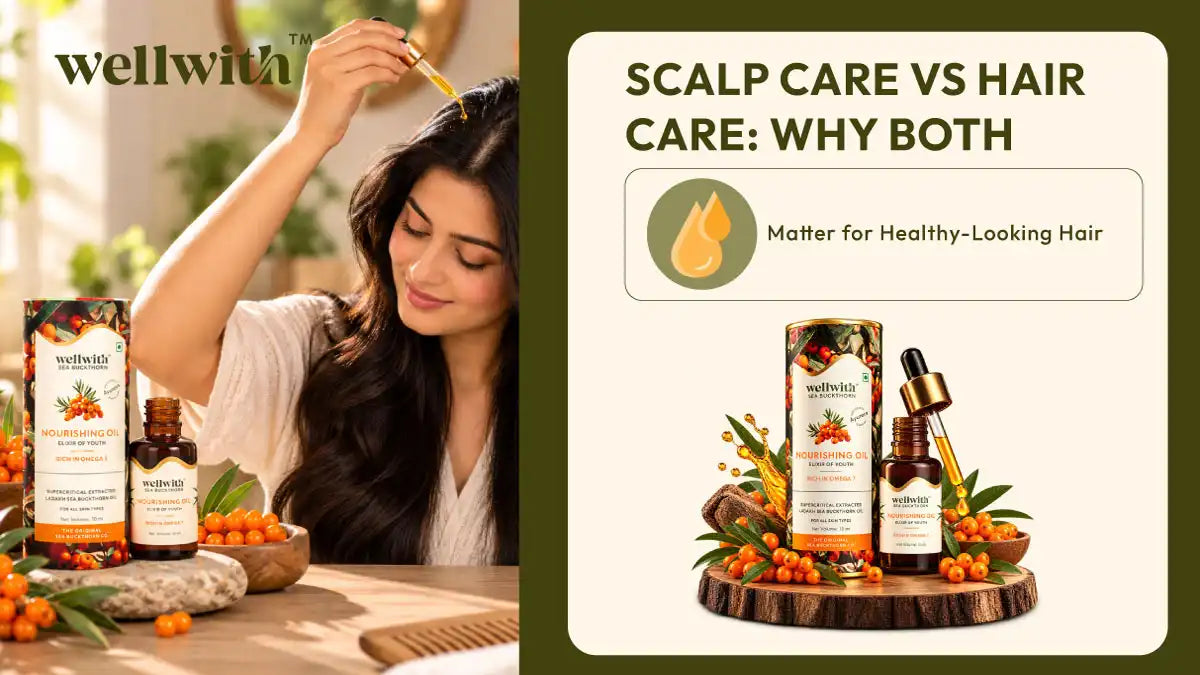

When we say, "I want to take better care of my hair," what we usually mean is a cleaner, more comfortable scalp, smoother strands, less frizz, and hair that simply looks healthier. However, your scalp is not quite the same as your hair. They require different forms of care. And thus, it is essential to understand their differences and importance rather than choosing who wins between scalp care and hair care.
The scalp is a part of the skin; it consists of hair follicles and oil glands and has its own barrier. The hair growing out of the scalp is composed of keratin, and once it grows out, it does not have the ability to heal itself as the living skin does, which is why your regimen should include caring for both of these.
Dermatologists recommend using shampoo to clean off the excess oil, build-up from the products, dead skin cells from the scalp; and the conditioner for the lengths of the hair to make it more comfortable and conditioned.
What Is Scalp Care?
Scalp care entails making sure that the scalp is clean, comfortable and balanced. In other words, picture the scalp as the foundation of the building. In cases where the scalp is oily, has excessive build up, is dry or irritated, applying products to the hair will not do any good until the scalp itself is taken care of. The following is a simple scalp care routine:
- Properly cleaning the scalp: The purpose of using shampoo is to clean the scalp, not the hair length.
- Choice of products based on the type of scalp: A person’s scalp that is oily and another one that is dry and sensitive may require totally different treatment.
- Gentler approach: Scrubbing and brushing the scalp too hard can lead to irritation.
- Monitoring: Persistent itching, unusual hair loss, or itching and redness may require consultation from a professional doctor, rather than just purchasing a new product.
What Is Hair Care?
Hair care is primarily concerned with the hair fibre. This is limited to the mid-lengths and ends. Once the hair is outside the scalp, it is completely exposed to the stress of its surroundings. Practices such as washing, drying, combing, tying it up in a ponytail, being under the sun, being exposed to pollution, and sometimes even colouring; all take a toll. These habits can cause tangles, hair breakage, and hair frizz.
A good hair care routine isn't about adding more products. It's about cutting down unnecessary damage.
Simple habits can make a meaningful difference
- After shampooing, run a little conditioner through the hair. This will provide more moisture and allow the hair to become more manageable.
- Don't vigorously scrunch your wet hair with a towel.
- Detangle gently as possible, particularly when the hair is wet and vulnerable to damage.
- Control exposure to excess heat from blow dryers, straighteners and curling devices.
- Opt for products suited to your hair type and specifically for what your hair actually needs.
Is There a Difference Between Scalp Care and Hair Care?
Here's an easy way to get the difference:
Scalp Care = Caring for the skin that grows your hair.
Hair Care = Caring for the strands that have already grown.
They are correlated, but not equivalent.
For instance, if a person has oily roots and dry ends and they constantly use clarifying shampoos along the entire length to control the oiliness of the scalp, the ends can become drier. Likewise, a person with a dry scalp will be only concerned about the masks and conditioners they apply on their hair ends. It feels much softer but still the concern exists at the scalp.
That is why the regimen should be centered around what the problem actually is.
Why Scalp Health Matters for Healthy-Looking Hair?
As hair follicles occur in the scalp, it means that scalp health will play a part in the general hair health. This does not imply that a healthy scalp will directly stop hair loss and grow new hair magically. Hair loss and shedding could result from several factors such as genetic predisposition, hormonal changes, nutrition, stress, medication, or problems related to the scalp. What good scalp care can provide is a healthy and clean environment for your hair to grow.
If you notice ongoing itching, excessive scaling, areas of hair loss or thinning of the hair, it is advisable to make an appointment with a dermatologist instead of trying to switch from one cosmetic to another.
Why hair lengths require different kind of care?
The hair ends have been subjected to water, brushing, styling, and exposure to the environment for the longest time; that’s why the ends always have the driest section. The easiest way to achieve healthy hair and scalp is by not caring for them in the same way.
While washing your hair, focus on cleaning the scalp while letting the shampoo rinse the lengths. Apply the conditioner to the sections where the hair requires manageability and softness.
If you have dry, curly, and textured hair, then you should apply the conditioner throughout the hair length. However, if you have fine and straight hair, you could apply it only to the ends.
It is more about knowing your hair, rather than following one predetermined routine.
Where Does Hair Oil Fit In?
Nourishing hair oil treatment may fit into a routine, especially when you want to infuse softness, manageability and sheen. But oiling your hair can also have completely two different meanings and maybe this is the reason most people get confused and don't get the result they want.
You can simply add some oil to your scalp and massage it, or you could add oil to the lengths and ends of your hair. However, the choice would depend on the type of your hair and the result you desire.
For example, adding a little bit of oil to the lengths of your hair can make it feel smoother and get rid of the dry and rough texture. On the other hand, adding oil to the scalp is a separate procedure which is not recommended to everyone because oily scalp can create problems if extra oil is added to it.
The idea is to use as much as you need.
A glimpse on Sea Buckthorn Oil
Sea buckthorn has been used in hair and scalp care for centuries. Its oil is naturally rich in various fatty acids and other compounds such as omega-7 (palmitoleic acid) and vitamin E as well as carotenoid compounds.
Well With's Sea Buckthorn Nourishing Oil is a CO₂-extracted oil that contains omega fatty acids and natural constituents. The product is made to nourish and hydrate skin and hair.
In case users search for “sea buckthorn oil for hair growth”, one needs to know what exactly they mean.
The healthy appearance of hair is connected with a proper condition of the scalp and hair follicles, however, hair fall is a complicated issue. So sea buckthorn oil shouldn’t be promoted as an absolute solution for hair fall or a replacement for medical treatment.
It could be used as a component of a general personal care system that includes hair nourishment and moisture of the scalp and appearance of healthier hair.
As a topical preparation, WellWith advises using it before hair washing or mixing a couple of drops with a carrier oil.
Common Hair Care Mistakes to Avoid
1. Don't Copy Someone Else's Hair Routine
The biggest mistake people make when it comes to hair is doing exactly what somebody else is doing, because their hair looks fabulous. Your friend's daily oiling routine may not be suitable for your oily scalp. For a person with low-maintenance hair, a ten-step routine could be overkill.
Curly-haired individuals sometimes use more conditioning than a person with fine straight hair.
Shampooing also varies. Your styling routine should solve your own hair problem rather than anybody else's.
2. Using Too Much Oil, or Putting It in the Wrong Place
More oil doesn't mean healthier hair. A few drops on dry ends can help hair feel smoother, but a heavy hand on an oily scalp can leave roots limp and sticky. Start small, see how your hair responds, and adjust.
3. Treating Persistent Scalp Problems With More Products
A new shampoo won't fix itching, heavy flaking or redness that keeps coming back. If the same symptoms hang around for weeks, or you notice patches of hair loss, that's a reason to see a dermatologist, not to add another bottle to your shelf.
The Bottom Line: Hair Lengths & Roots Care
The perfect hair day isn't achieved with just one magical hair product. The key is to understand that your scalp and hair aren't the same thing. Your scalp needs appropriate cleaning and care. Hair lengths need conditioning, proper detangling, heat protection, and styling with caution.
There is no need to purchase every hair care product mentioned in the latest viral posts on social media. Get down to basics of healthy hair, know your hair type, take good care of your scalp, and introduce new products step by step. If you would like to find a plant-based hair care product, check WellWith's CO₂ extracted Sea Buckthorn Nourishing Oil, which is made to nourish your skin and hair. The effective hair care routine isn't necessarily complicated. It's doing what needs to be done consistently.
Once you've decided to develop your own hair care routine, feel free to explore and buy hair care products online.
FAQs
1. Is shampoo for the scalp or the hair?
Shampoo is meant to cleanse the scalp. The conditioner adds moisture to the lengths and ends, so focus it there rather than on your roots.
2. Is it safe to use a single formula on both my scalp and hair?
Not really. Remember that your scalp is skin and you may need to take a different approach here versus what you need to do with the visible hair fibre in terms of conditioning, detangling and minimising physical and heat damage.
3. Is my scalp oily or dry?
Monitor how often your scalp becomes oily after you cleanse. If your scalp becomes oily very fast, then you may need to cleanse more frequently. In case you always have issues with scalp itchiness and tightness, it could be a scalp condition that requires medical help.
4. Can hair oil take the place of a conditioner?
No. A conditioner is made to make hair soft, manageable and easy to comb. An oil can add softness and nourishment, but it doesn't do the same job.
5. Can I use sea buckthorn oil for any kind of hair?
Yes, you may use sea buckthorn oil in any of your preferred hair care regimen, but it depends on your hair and scalp type as to the amount of sea buckthorn oil and areas you will be applying it. Too much oil on fine and oily hair would make it oily and limp, while dry hair can accommodate more oil.
6. How often should I oil my scalp?
There isn't really a definite answer to this since everything will always depend on your scalp type and how greasy your scalp becomes easily. If you are irritated with your scalp after you apply the oil, then lessen or stop it.
7. Can heat styling have an effect on hair health?
Yes, application of excessive heat could damage the hair shaft resulting in dryness, brittle and broken hair. Lowering the level of heat, reducing the frequency of heat application and using heat protectants can help in minimizing the risks of damage.
8. How Do I Know That My Scalp Is Healthy?
The healthy scalp usually does not cause any discomfort. It is not itchy and flaky. If there is itching, flaking or redness, it is better to see a doctor. The flakes are not alike so better to go for a check-up than make assumptions.